

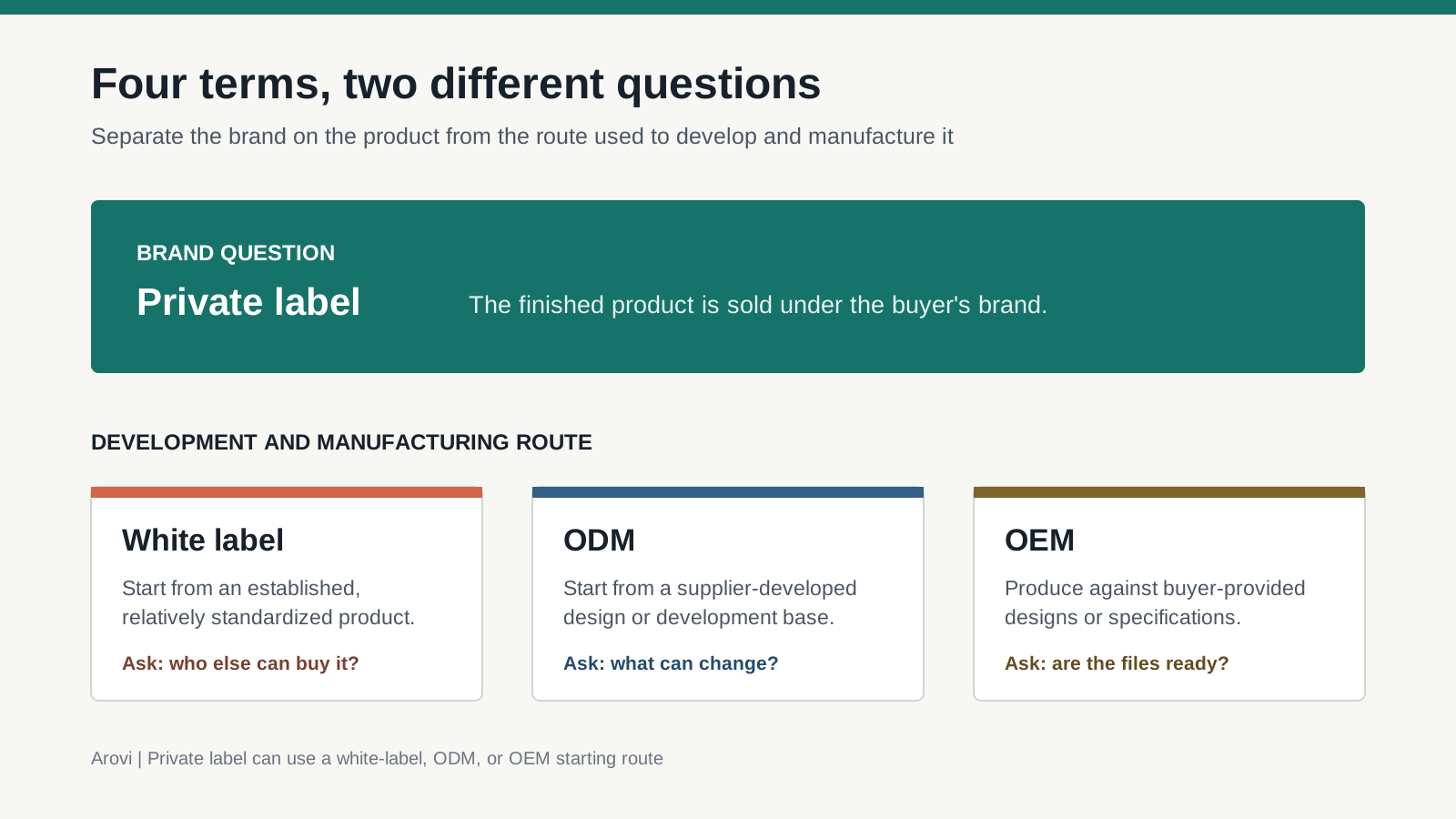
Private label tells you whose brand appears on the finished product. White label usually describes an established product that several buyers may sell under different brands. OEM and ODM describe the work split: in an OEM-style project, the buyer provides the detailed requirements; in an ODM-style project, the supplier contributes more of the design and development base.
The terms are not used consistently across every industry or supplier. Treat them as a starting vocabulary, then confirm what already exists, what can change, what each party must provide, and who owns or may reuse the result.
The Difference in One Table
| Term | Main question it answers | Typical starting point | Buyer input | What still needs confirmation |
|---|---|---|---|---|
| Private label | Whose brand will the product carry? | A product sold under the buyer's brand | Brand, market, artwork, packaging, and approvals | Product origin, customization, exclusivity, and ownership |
| White label | Is the core product already standardized? | An established product offered to more than one buyer | Branding and selected packaging choices | Which elements can change and whether competitors can buy the same product |
| OEM | Is the supplier producing to buyer-provided requirements? | Detailed buyer design or specification | Technical files, requirements, and approval standards | Whether the files are production-ready and how changes are controlled |
| ODM | Is the supplier providing the design or development base? | Supplier-developed design, platform, or product direction | Selection, adaptation requests, branding, and approvals | Permitted changes, exclusivity, and ownership of designs, molds, or formulas |
The labels overlap. A product may be private label because it carries your brand while also following a white-label, OEM, or ODM development route.
Why the Work Split Matters More Than the Acronym
These models divide product capabilities between the buyer and supplier. The OECD's work on global value chains explains that companies can participate in production networks without developing every capability internally, while manufacturers can move from assembly into sourcing, design, and branding.
That flexibility creates leverage, but it also changes what must be managed. A Harvard Business School case on ASUSTeK separates branded business, ODM, and contract manufacturing as different organizational capabilities. It also examines what can happen when a buyer outsources substantial product design to an ODM that later develops its own brand.
The practical lesson is not that ODM is risky or OEM is safer. It is that design responsibility changes the relationship. Harvard Business Review's guidance on design outsourcing highlights risks such as misaligned objectives and unexpected rivalry. Buyers should therefore define decision rights, design ownership, permitted reuse, revision control, and approval standards before development begins.
What Does Private Label Mean?
A private-label product is made or supplied by one company and sold under another company's brand. The brand owner controls the customer-facing identity, including the brand name, positioning, artwork, packaging, and sales channel.
Private label does not by itself tell you:
- Whether the product is unique
- How much customization is included
- Whether a design or formula is exclusive
- Who owns tooling or intellectual property
- Which party developed the core product
Some suppliers use "private label" narrowly for an existing product with custom branding. Others use it broadly for almost any outsourced product sold under the buyer's brand. Neither usage tells you who designed the product or whether it is exclusive.
GS1's product-identification guidance gives a concrete example of this separation: the brand owner is normally responsible for assigning the product's Global Trade Item Number, or GTIN, regardless of where or by whom the product is manufactured.
What Does White Label Mean?
In common commercial usage, a white-label product is an established, relatively standardized product that a supplier can offer to multiple buyers for sale under different brands. The buyer typically changes the brand presentation rather than the core product.
White label may fit when:
- You want to test a category before investing in deeper development
- The existing product meets your essential requirements
- Your main differentiation will come from branding, packaging, channel, or service
- Limited core-product changes are acceptable
Before choosing this route, ask which parts are standard, which parts can change, and whether the same product is available to other brands. Also confirm whether the existing product and documentation suit the destination market. A new label creates neither product exclusivity nor automatic market readiness.
What Does OEM Mean?
OEM stands for original equipment manufacturer. In the sourcing model relevant to many private-label projects, an OEM produces a finished product to specifications provided by the customer.
OEM may fit when you already have:
- A detailed product specification
- Technical drawings or a complete design
- A formula or bill of materials you control
- Required tolerances and performance criteria
- Defined testing and approval requirements
A mood board, reference photo, or product idea is not automatically an OEM-ready package. The manufacturer may still need dimensions, materials, components, tolerances, artwork, testing requirements, and an approved reference sample.
The World Intellectual Property Organization describes OEM production as making a finished product according to customer specifications. Its discussion also shows why the acronym can carry different nuances across sectors: the actual contract and division of work remain decisive.
What Does ODM Mean?
ODM stands for original design manufacturer. An ODM provides manufacturing plus more of the underlying product design or development work. The buyer starts from a supplier-developed design, platform, formula direction, or technical solution and selects permitted adaptations.
ODM may fit when:
- You know the customer and desired product outcome
- You do not have a production-ready specification
- You want more adaptation than a basic white-label route offers
- You need an established development base
Ask what the supplier already owns, which changes are available, whether the adapted result is exclusive, and who owns any new design, mold, tooling, source file, or formula work. ODM does not automatically transfer the resulting intellectual property to the buyer.
Which Model Should You Choose?
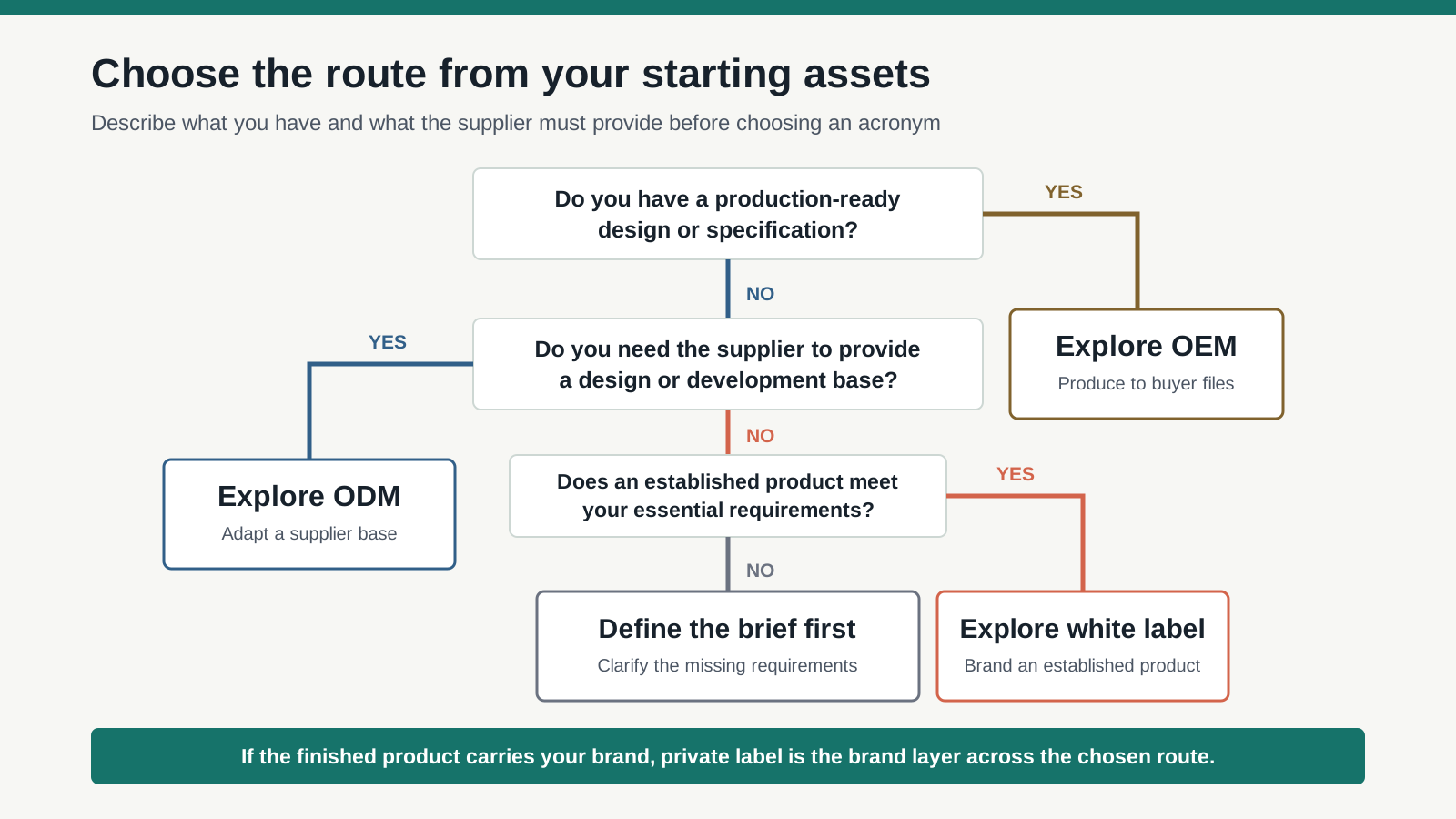
Do not choose the most impressive-sounding label. Start with what you can provide today and what the supplier must add.
Choose a white-label starting point when:
You want an established product with limited changes, and speed of market testing matters more than core-product differentiation.
Explore ODM when:
You have a clear product concept and customer, but you need the supplier to provide a design or development base that can be adapted.
Explore OEM when:
You already control a detailed design or specification and need a manufacturer to produce against defined requirements.
Use private label as the brand model when:
The finished product will carry your brand. Then identify whether the underlying development route is white label, ODM, OEM, or another form of contract manufacturing.
If you do not have a production-ready specification, do not need a supplier-developed base, and cannot accept an established product, define the missing product requirements before approaching manufacturing partners.
If you still cannot choose from these descriptions, do not force the project into an acronym. Describe your starting assets and the outcome you need, then ask the supplier to explain the proposed work split.
A Better Five-Question Decision Test
Ask these questions before discussing model names:
- What already exists? Is there a finished product, a supplier design, or only your concept?
- What can you provide? Do you have artwork, references, specifications, drawings, a formula, or approval criteria?
- What must be different? Separate essential product differences from branding and packaging preferences.
- What must be exclusive or owned? Identify expectations for the product, design, formula, mold, tooling, and artwork.
- What must the supplier develop? Define the missing design, engineering, formulation, sampling, packaging, or documentation work.
These answers create a clearer sourcing brief than simply writing "OEM required" or "looking for private label."
What Should You Confirm With a Supplier?
Regardless of the model, request written answers to these questions:
- Which parts of the proposed product already exist?
- Which parts will be newly developed?
- What can change at the expected quantity?
- What files and decisions must the buyer provide?
- What samples or prototypes are required?
- Who owns existing and newly created designs, formulas, molds, tooling, and artwork?
- Can the same product or design be offered to another buyer?
- What specification and reference sample will control production?
- Which testing, labeling, or documentation questions must be resolved for the destination market?
- Which assumptions are included in the quotation?
Record the answers in the brief, specification, quotation, and contract as appropriate. The model name is shorthand; the written project details control the work.
What These Terms Do Not Decide
None of the four labels automatically determines:
- Product quality
- Price or minimum order quantity
- Sampling or production time
- Regulatory suitability
- Testing scope
- Exclusivity
- Intellectual-property ownership
- Whether the supplier is a good fit
These depend on the product, market, quantity, specification, supplier, and written agreement.
Turn the Model Into a Useful Project Brief
Choosing a label is only the first step. A supplier still needs to understand the product, customer, destination market, expected quantity, customization priorities, packaging, references, and approval requirements.
Read How to Start a Private Label Brand for the broader planning process. Before requesting pricing, use the Private-Label Quote Request Checklist to organize the scope and assumptions. To see how Arovi structures the sourcing journey, review How It Works. When your direction is clear, use Start A Project to share the essentials.
Sources
- World Intellectual Property Organization, World Intellectual Property Report 2022: The Direction of Innovation, accessed 2026-07-18.
- OECD, Connecting Local Producers in Developing Countries to Regional and Global Value Chains, OECD Trade Policy Papers No. 160, accessed 2026-07-18.
- Harvard Business School, Willy Shih, Howard Yu, and Hung-Chang Chiu, Transforming ASUSTeK: Breaking from the Past, accessed 2026-07-18.
- Harvard Business Review, Jason Amaral and Geoffrey G. Parker, Prevent Disasters in Design Outsourcing, accessed 2026-07-18.
- GS1, Who is responsible for numbering trade items?, accessed 2026-07-18.