
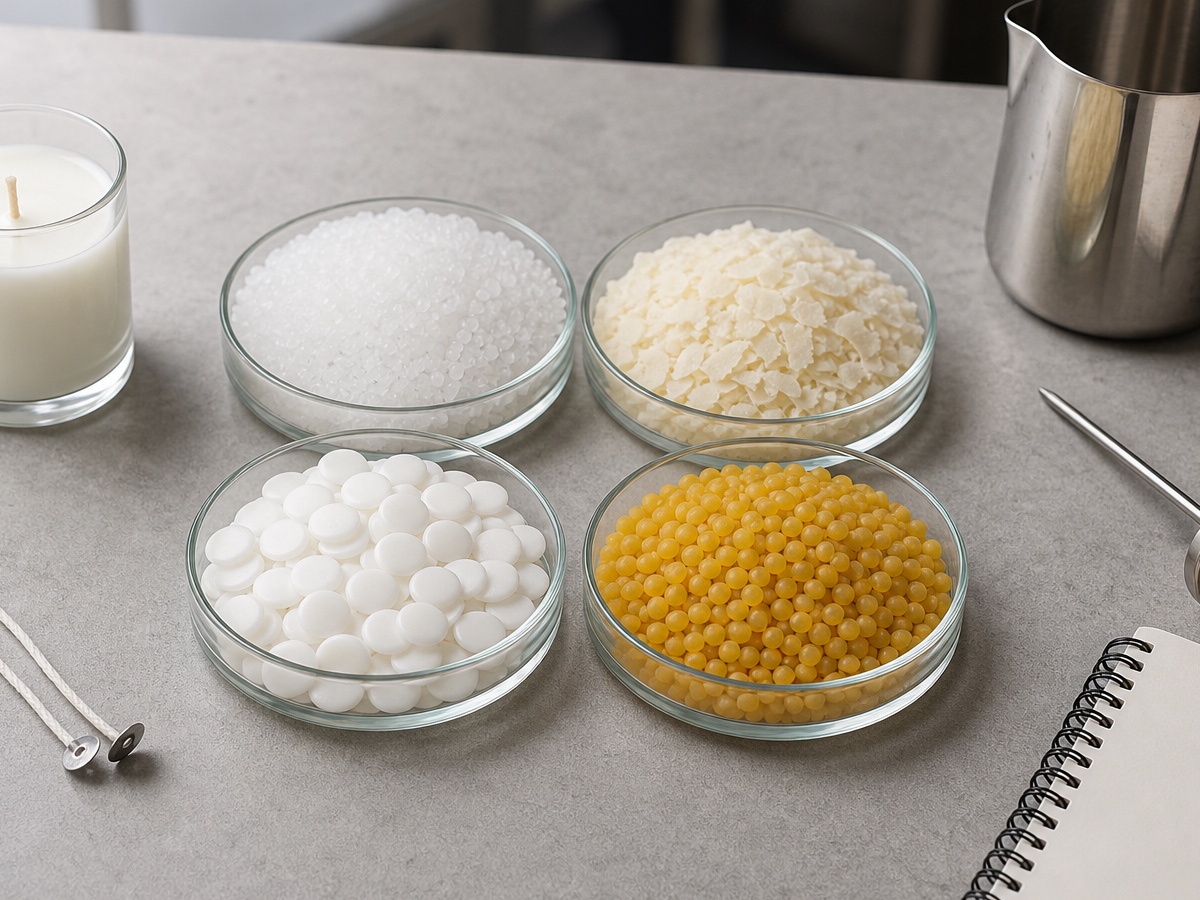
The main candle wax families include paraffin, soy, coconut, beeswax, palm, stearin, and proprietary blends. No wax is universally best. For a scented-candle project, buyers should compare the candle format, desired appearance, fragrance and wick system, temperature and distribution conditions, sourcing evidence, label claims, cost, and test results for the complete candle.
That answer is less dramatic than "soy wins" or "paraffin throws scent best," but it is far more useful. A wax name identifies a material family, not a finished performance specification. Two waxes sold under the same family name may have different compositions, additives, melting behavior, supplier instructions, and intended applications.
Candle Wax Types at a Glance
| Wax family | Material starting point | Useful buyer perspective | Questions to resolve |
|---|---|---|---|
| Paraffin | Refined petroleum-derived waxes | Broad family with grades and blends developed for different candle formats | Which grade or blend, what specification, and what finished-candle test evidence? |
| Soy | Usually hydrogenated soybean oil, sometimes used in blends | Plant-derived positioning with formulation and appearance considerations that vary by grade | Is it 100% soy wax or a soy blend, and what supports the label wording? |
| Coconut | Coconut-oil-derived candle wax, commonly encountered in commercial blends | Often selected for a soft, pale visual direction or blend story | What is the actual blend, and is it suitable for the format and distribution conditions? |
| Beeswax | Wax produced by honeybees | Distinct material origin, color, aroma, and brand-story implications | Is the natural color or aroma compatible with the intended fragrance and claims? |
| Palm, rapeseed, stearin, and others | Plant, animal, mineral, or manufactured feedstocks depending on material | May fit a regional, format, sourcing, or formulation objective | What is the exact identity, origin, certification basis, and intended application? |
| Proprietary blend | Two or more waxes and possible performance additives | Designed to balance properties rather than maximize one material story | Which ingredients or claims can be disclosed and substantiated? |
The National Candle Association notes that manufacturers use paraffin, beeswax, soy, palm, gel, synthetic waxes, and many blends. Its central point is useful: no single wax type is automatically best for all candle making.
Paraffin Wax
Paraffin is a family of refined petroleum-derived waxes. It is widely used in candles, but "paraffin" does not describe one universal grade or finished formulation.
For buyers, its advantages and limitations should be evaluated at product level. Ask:
- Is the candidate intended for containers, pillars, votives, melts, or another format?
- Is it straight paraffin or a blend?
- What supplier specification and handling guidance apply?
- How does the candidate behave with the intended fragrance, dye, wick, and vessel?
- What appearance is acceptable after cooling, storage, and repeated burns?
- Which sourcing, labeling, or brand-positioning questions matter to the market?
Avoid converting general reputation into a guarantee. Statements such as "paraffin always gives the strongest scent" or "paraffin is always dirtier" ignore grade, wick, fragrance, additives, vessel, burn conditions, and product design.
Soy Wax
Soy wax is generally made by hydrogenating soybean oil so that the oil becomes more solid. A USDA National Organic Standards Board document describes soy wax as hydrogenated soybean oil and explains that hydrogenation chemically changes the oil.
That definition matters because "plant-derived" and "unprocessed" are not synonyms. It also does not tell a buyer whether a commercial candle wax is pure soy or a blend.
When evaluating soy wax, ask:
- What percentage and type of soy-derived wax is present?
- Are paraffin, coconut, palm, or other waxes and additives included?
- Which statement will appear on the product or marketing materials?
- What evidence supports "soy," "soy blend," or percentage wording?
- How does the tested candle respond to cooling, storage, fragrance, color, and repeated burn cycles?
Soy waxes can show surface and color behavior that buyers may either accept as part of the material character or define as an appearance concern. The acceptable range should be agreed from actual samples, not copied from a generic description.
Coconut Wax
"Coconut wax" often refers to candle materials derived in part from coconut oil, but commercial products may be blends formulated with other waxes. The family name alone does not reveal hardness, composition, melting behavior, fragrance compatibility, or temperature tolerance.
Ask for the product specification and claim basis rather than assuming that every coconut wax is equivalent. Important questions include:
- Is the wax straight, hydrogenated, or blended?
- Which other waxes or additives are present?
- Is the candidate intended for the chosen candle format?
- How does it behave in the expected storage and shipping temperatures?
- Does the final appearance remain acceptable after thermal cycling and use?
- Can the intended coconut or percentage claim be documented?
Because some coconut-based materials are relatively soft, blends may be used to reach a target structure or handling profile. That is a formulation decision, not evidence that a blend is inferior.
Beeswax
Beeswax is produced by honeybees and has a distinct material origin. Its natural color and aroma can vary, which may be desirable for an unscented or material-led product but may complicate a tightly controlled color or fragrance direction.
Buyers should consider:
- natural versus refined appearance;
- color and aroma variation;
- availability and traceability;
- animal-derived and vegan-positioning implications;
- compatibility with added fragrance and color;
- candle format and wick development;
- evidence for purity, origin, or sourcing claims.
Beeswax does not become the "best" wax merely because it is familiar or naturally produced. It may be the right choice when its identity serves the product concept and the finished candle passes the required tests.
What About Palm, Rapeseed, Stearin, Gel, and Blends?
These are not fringe materials, and buyers should not force every project into a four-wax comparison.
- Palm and rapeseed waxes may support a regional or plant-derived material direction, subject to formulation and sourcing evidence.
- Stearin can refer to materials derived from fatty acids and used alone or in blends; exact origin matters for claims.
- Gel candles use a different transparent fuel system and need format-specific development.
- Proprietary blends combine waxes and additives to target a working profile.
A blend can be a deliberate engineering choice. It can also make vague front-label claims misleading. Ask for the composition information needed to approve product wording, while recognizing that a supplier may protect confidential formulation details.
Compare Wax by Seven Decisions, Not One Ranking
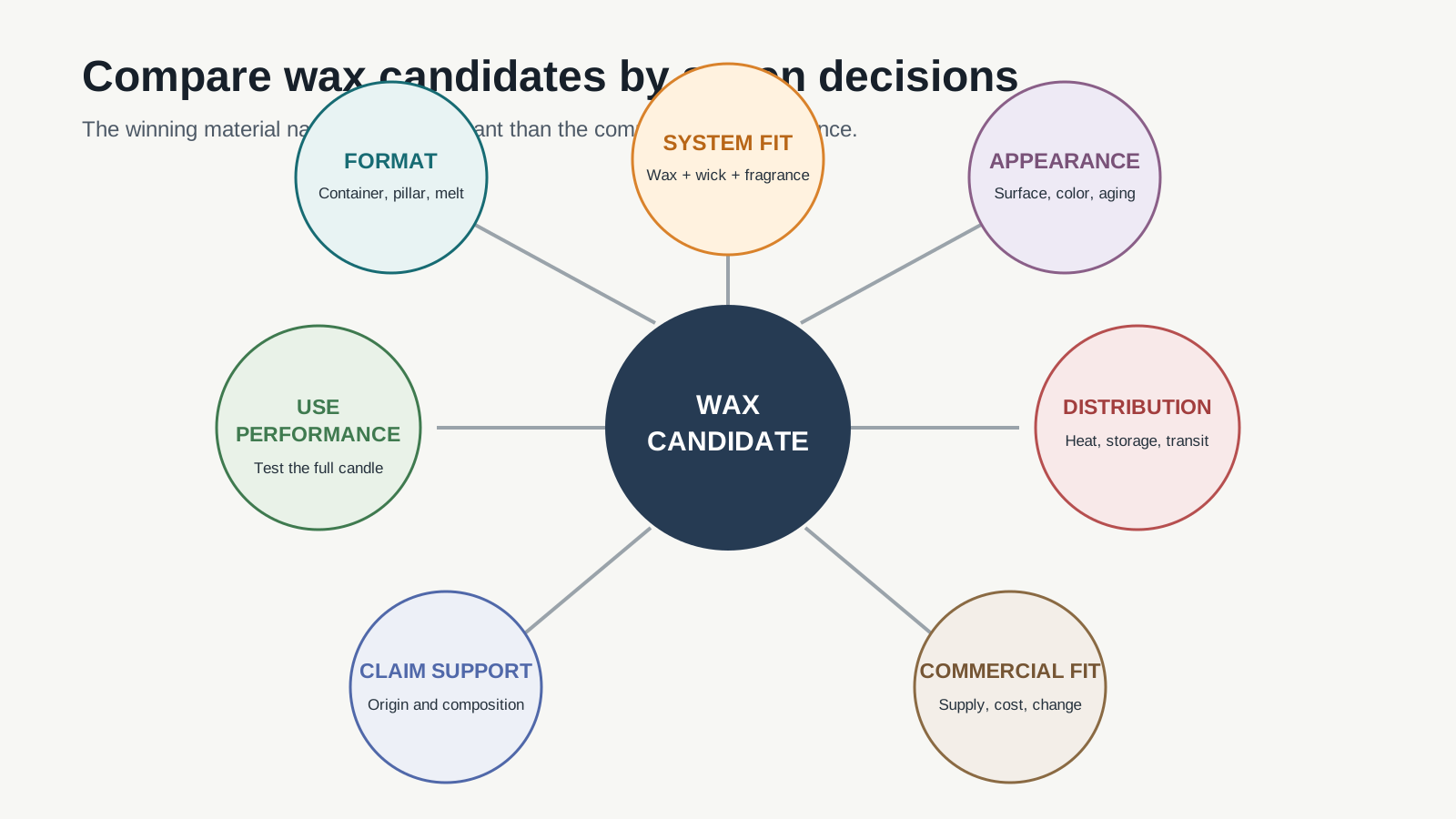
Score each candidate against the same seven questions:
- Format: Is it intended for the selected vessel, pillar, votive, melt, or other design?
- System fit: Can the wax, fragrance, dye, wick, vessel, and additives be developed as one stable system?
- Appearance: What surface, color, adhesion, shrinkage, or aging behavior is acceptable?
- Use performance: What burn, flame, melt-pool, visible-emission, and end-of-life evidence is required?
- Distribution: What temperatures, storage time, handling, and transport conditions must the product tolerate?
- Claim support: Can origin, composition, percentage, vegan, natural, or sustainability wording be substantiated?
- Commercial fit: Are supply, lot consistency, quantity, cost, and change control workable for the project?
The weighting should follow the product brief. A material-story candle may weight traceability and appearance heavily. A warm-climate retail program may focus on storage and distribution behavior. A highly fragranced container candle may prioritize system development and repeated burn evidence.
Does Wax Type Determine Scent Throw?
Not by itself. Cold throw and hot throw are outcomes of the complete product and test conditions. Wax formulation, fragrance composition and amount, cure and storage conditions, wick selection, vessel geometry, flame behavior, room size, airflow, temperature, and sensory method all contribute.
A wax supplier's recommended use range is a development starting point, not proof that a finished candle will perform as intended. Compare complete candle candidates under controlled conditions and change one meaningful variable at a time.
Is Soy Wax Cleaner or Safer Than Paraffin?
A broad material label is not enough to support that conclusion. Peer-reviewed chamber research has shown that candle composition influences measured emissions and that raw-material quality and additives can matter. Another controlled study comparing four wax fuels and multiple fragrances evaluated the complete candle combinations rather than declaring safety from the wax name alone.
The practical buyer lesson is not that all candles are identical. It is that "clean," "non-toxic," and "safe" are high-risk claims requiring precise definitions and suitable evidence. Do not use material origin as a substitute for finished-product safety review.
In the United States, CPSC business guidance points candle companies to standards including ASTM F2417 for fire safety, ASTM F2326 for visible emissions, ASTM F2058 for fire-safety labeling, and ASTM F2179 for certain glass candle containers. CPSC materials describe F2417 as applying across candle base materials and candle types. Applicable requirements still depend on the actual product and market.
How Should Buyers Test Candle Wax Candidates?
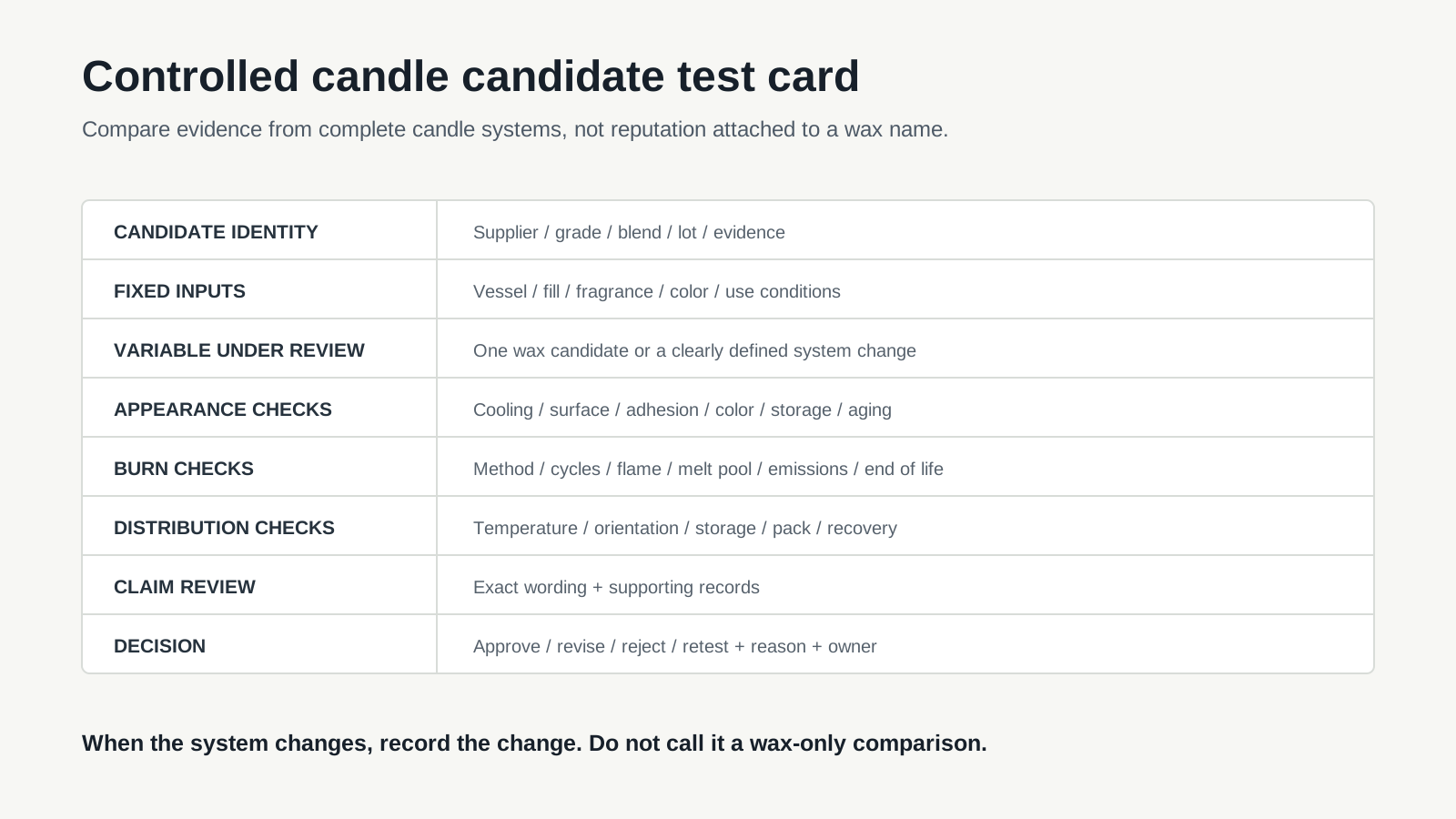
Build a controlled candidate test card for each complete candle:
| Field | Record |
|---|---|
| Candidate identity | Wax supplier, grade or blend, lot, and composition evidence available |
| Fixed inputs | Vessel, fill, fragrance, color, wick family, and intended use conditions |
| Variable under review | Wax candidate or clearly defined system change |
| Appearance checks | Pour result, cooling, adhesion, surface, color, storage, and aging observations |
| Burn checks | Test method, cycles, flame behavior, melt pool, residue, visible emissions, vessel observations, and end-of-life result |
| Distribution checks | Defined temperature, orientation, storage, pack, and recovery conditions |
| Claim review | Exact proposed wording and supporting records |
| Decision | Approve, revise, reject, or retest, with reason and owner |
When changing wax requires a different wick, fragrance level, additive, or process, record that change openly. The comparison is then between two optimized systems, not a laboratory-style single-variable test. Both approaches can be useful, but they answer different questions.
A Better Wax Brief for a Private-Label Candle
Before requesting samples or a quotation, state:
- candle format and vessel reference;
- destination market and sales channel;
- fragrance and color direction;
- material preferences and unacceptable materials;
- exact claims being considered;
- expected storage and distribution conditions;
- appearance priorities and acceptable variation;
- target quantity range and SKU structure;
- test, labeling, documentation, and packaging questions;
- whether alternative wax or blend proposals are welcome.
Use Arovi's private-label quote request checklist to organize the wider project. If you are still deciding how much development you need, compare private label, white label, OEM, and ODM before asking suppliers to quote different assumptions.
Choose a Testable Direction, Not a Winning Buzzword
The best wax is not the one with the strongest marketing reputation. It is the documented candidate that fits the product brief and works with the fragrance, wick, vessel, packaging, market, and distribution conditions.
Explore Arovi's Home Fragrance category and start a project with your candle format, market, quantity range, wax preference, fragrance direction, packaging, intended claims, and target date. Material availability, composition, formula, performance, testing, documentation, MOQ, pricing, and timing require project-specific confirmation.
Sources
- National Candle Association: Elements of a Candle - Wax, accessed July 22, 2026.
- USDA National Organic Standards Board: Soy Wax Technical Review and Proposal, accessed July 22, 2026.
- U.S. Consumer Product Safety Commission: Candles Business Guidance, accessed July 22, 2026.
- ASTM International: F1972-26 Standard Terminology for Candles and Associated Accessory Items, accessed July 22, 2026.
- PubMed: Emission of Air Pollutants From Burning Candles With Different Composition, accessed July 22, 2026.
- PubMed: Measurement and Evaluation of Gaseous and Particulate Emissions From Burning Scented and Unscented Candles, accessed July 22, 2026.